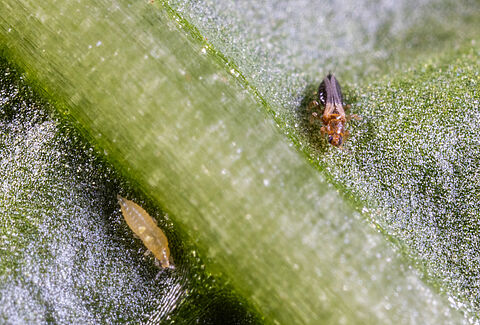
HOWELL, Mich. – As fall turns toward winter, greenhouses fill with cuttings and liners for the winter and early-spring propagation season. Since covered crops keep the houses warm, Thrips parvispinus (Tp) can overwinter among the plants. Koppert encourages growers to build a prevention program now, before an incident becomes a loss.
Tp is documented in multiple states, and it travels easily on the plant material growers bring in. It hides in leaf folds and lays its eggs inside the plant. By the time growers see damage, Tp has already settled in. Early scouting, regular monitoring and a plan for the first sign keep a small find from becoming a large problem.
The Parvispinus Toolkit
Tp spends its life in more than one place, so Koppert built a toolkit to match. Together, these products give growers the means to control Thrips parvispinus in both the foliage and the growing medium.
Limonica hunts. This predatory mite (Amblydromalus limonicus) hunts young thrips larvae on the foliage. It pierces its prey and extracts the contents, and it stays active in both cooler and warmer conditions. Growers sprinkle it directly onto the leaves.
Capsanem targets. This beneficial nematode (Steinernema carpocapsae) targets thrips pupae in the soil. The nematodes enter the pest and release symbiotic bacteria into its body cavity, and the pest dies. Growers apply Capsanem to the growing medium as a drench or spray.
Isarid™ suppresses. This mycoinsecticide (Isaria fumosorosea) suppresses thrips and other soft-bodied pests as well. Its spores attach to the pest’s body, penetrate the cuticle and grow inside the host, which reduces feeding and eventually kills it. Growers can use Isarid in both foliar and soil applications.
Backed by a National Network of Technical Advisors
As always, Koppert products are backed by a national network of technical advisors who explain both the science and the field techniques. They know where Tp hides, what it damages and how to manage it.
Targeting the known weaknesses at the right time is critical to success when managing Tp. Koppert advisors know the Tp lifecycle well, so they know where each tool fits into the appropriate stages of the pest’s development.
To prevent its movement through a crop, advisors can tailor product timing and rates to fit an existing IPM program. Their advice comes from years of on-site visits and field experience deploying working solutions to combat this pest.
Contact Koppert
Uncertain about the scope and scale of your problem? Contact the Koppert technical advisors. They have the answers and their support is free to customers. Growers who want to try the toolkit can request a consultation, or call Koppert Biological Systems, Inc., 1502 Old US-23, Howell, MI 48843, +1 (800) 928-8827.
Product availability and registration vary by state. Always read and follow the label.
About Koppert
Founded in 1967, Koppert is a leader in biological crop protection, pollination and plant health solutions, serving growers in more than 100 countries.