For many years, the effectiveness of natural enemies was primarily measured by their voracity or their ability to consume pests. The greater the level of predation, the more effective the biological control agent was considered to be.
However, experience with invasive pests such as Thrips parvispinus has highlighted another factor that is equally important and, in many cases, even more decisive: establishment.
After all, a predator cannot control a pest if it fails to survive, reproduce, and successfully colonize the crop.
What Does It Mean for a Natural Enemy to Establish?
Simply put, establishment occurs when a population of beneficial organisms successfully adapts to the crop and remains active long enough to provide continuous protection.
This involves much more than simply releasing beneficials into the crop.
To establish successfully, a natural enemy must be able to:
- Survive under the environmental conditions present within the crop.
- Find sufficient food resources to remain active.
- Reproduce and generate new generations.
- Disperse throughout different areas of the plant.
- Respond rapidly to the arrival of the pest.
If any of these factors are missing, beneficial populations may develop too slowly, or even disappear before they can provide effective protection.
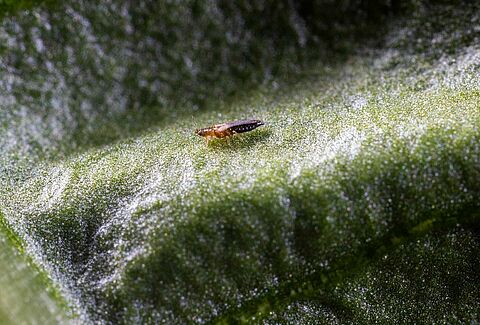
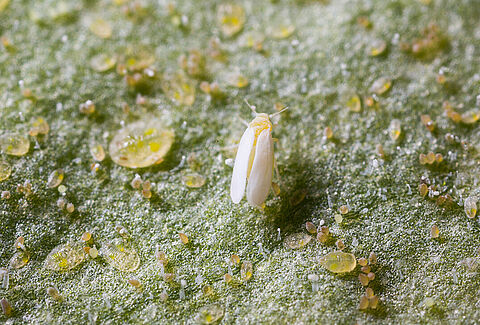
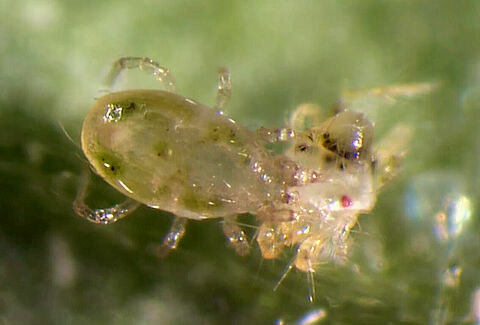
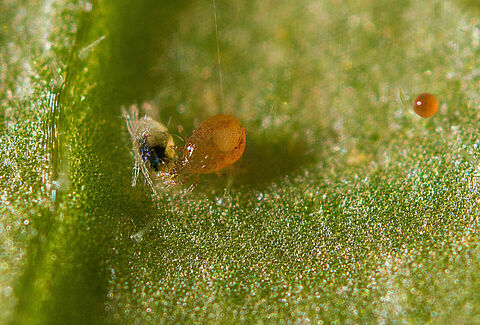
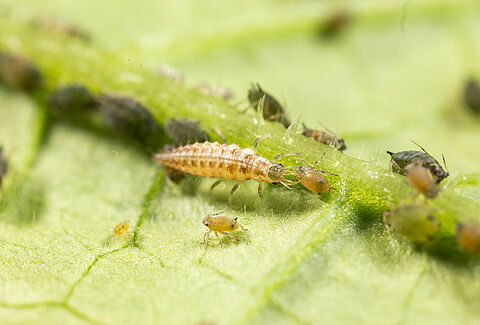
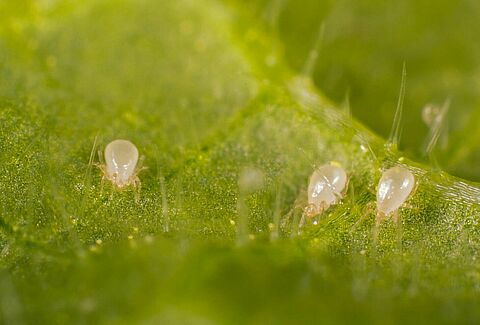
 A close-up view of the predatory mite Amblydromalus limonicus patrolling a healthy leaf, actively seeking out thrips before visible crop damage occurs.
The Race That Happens Before Symptoms Appear
Most crop protection decisions are made when damage becomes visible on flowers, fruit, or foliage.
Yet, weeks before those symptoms appear, a silent competition is already underway.
On one side, Thrips parvispinus populations are attempting to establish themselves within protected areas of the crop. On the other, natural enemies are working to colonize those same spaces.
In this race, timing is everything.
If the pest establishes itself first, its reproductive rate can quickly outpace the response capacity of any delayed intervention. Conversely, when beneficial predators are established proactively, pest populations can be suppressed before economic damage occurs.
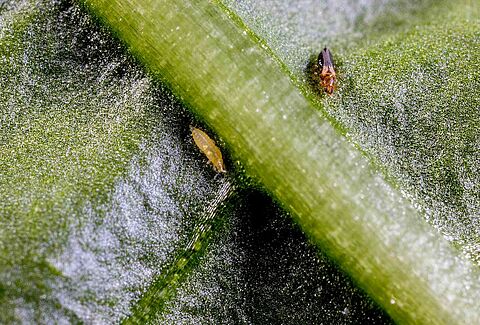
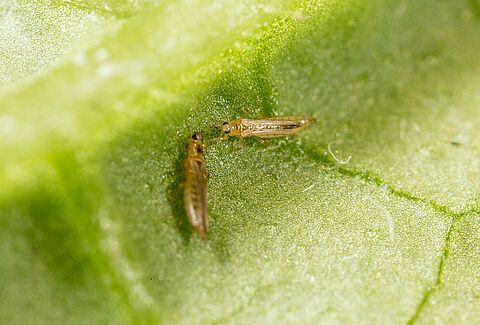
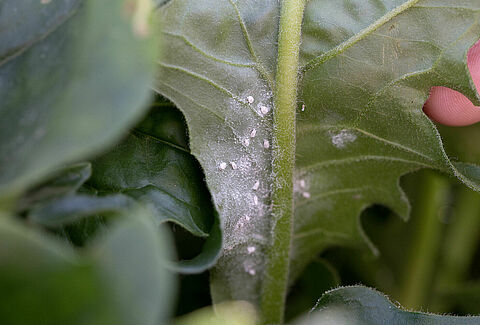
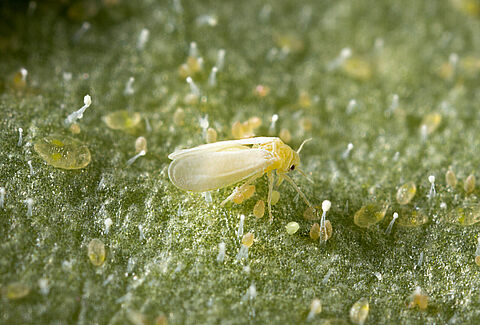
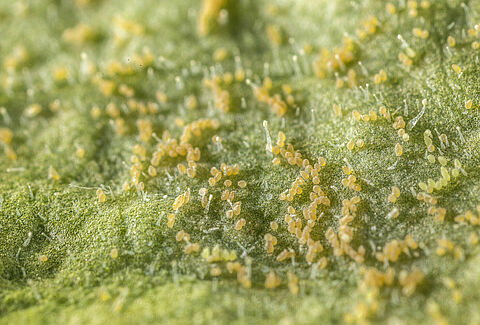
 Dense colonies of Thrips parvispinus larvae feeding on tender young leaves near the buds, illustrating how quickly this pest can multiply on unprotected crops.
Not All Natural Enemies Respond the Same Way
The ability to establish varies significantly among species.
Factors such as temperature, humidity, food availability, and plant architecture can directly influence how quickly beneficial populations develop and spread throughout a crop.
Some organisms require very specific conditions to thrive. Others are more adaptable and remain active even as environmental conditions fluctuate.
In an agricultural landscape characterized by increasing pest pressure and more variable growing conditions, the key question is no longer:
How many pests can a predator consume per day?
Instead, growers should be asking:
Will that predator be present and active when the pest begins to establish itself?
Establishment as a Strategic Advantage
The emergence of pests such as Thrips parvispinus is changing the way growers and crop advisors evaluate biological control solutions.
Today, effective biological control agents must be able to:
- Establish rapidly.
- Adapt to changing environmental conditions.
- Maintain active populations over time.
- Colonize the crop efficiently.
- Respond early to pest pressure.
In other words, effectiveness is no longer determined solely by predation capacity.
It is also determined by the ability to build stable beneficial populations that work preventively, before pest populations reach economically damaging levels.
In today's IPM programs, success often comes down to a simple principle:
The first population to establish gains the advantage.
Ready to Learn About the Next Generation of Biological Control Tools?
Don't miss our next article:
More Than 30 Years Behind a Different Solution: The Story of Amblydromalus limonicus
Discover how decades of scientific research, biological selection, and innovation led to the development of one of the most advanced predatory mites available for thrips and whitefly management.